
D-Day 2026

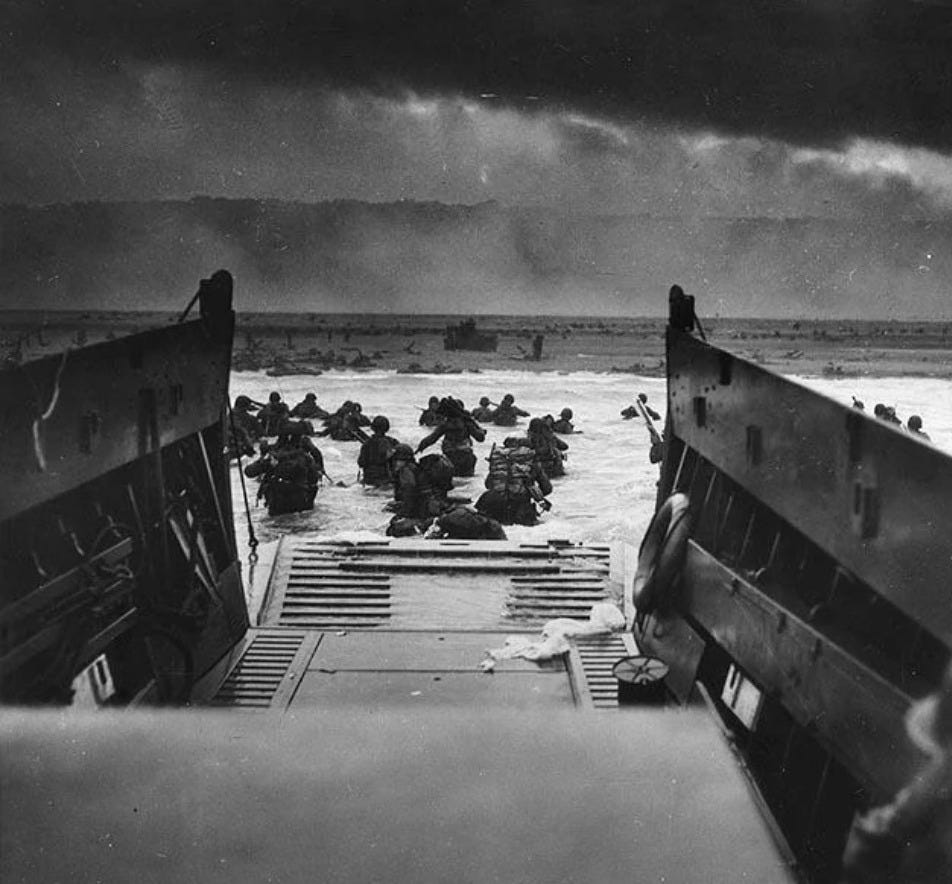
Today I woke up thinking of those fresh-faced farm boys, how many of them had never even managed to slip a hand inside a bra, had to leave such things as nipples and other of life’s mysteries to the realm of imagination, to go jumping off Higgins boats into an unending torrent of Nazi lead on this day eighty-two years ago.
Many of those fresh-faced boys became war-hardened men in seconds. For about seventy-five percent of those boys—three in four in the first waves on Omaha Beach—running out of the waters of the English Channel toward the battery of Nazi machine-gun fire would be the last thing they ever got to do.
How many of those boys died on that day not knowing the answer to the mysteries of unclasping a brassiere and so many of this life’s other wonders? Too young to have lived much, June 6th 1944 found them dead in that water and on that beach.
I wonder often what made them run into that firestorm. Was it as simple as mom and apple pie? Was it a belief in something better and bigger than all of us? Was it a dream or an ideal? Was it all just another piece of the lie we’ve all been sold since the days of this nation’s founding? I believe the Nazi threat was very real. I don’t think they got on those boats for their government, but for what America meant to them.
I wonder often where that courage came from. What was so valuable to a young boy that running into a hail of bullets made putting it all on the line somehow worth it? Too young to know much at all about life, but certain in their souls that this single act was something in which they had no choice. To call this courage is an insult to these men and boys. It was something deeper than courage, something that transcends bravery. Maybe being brave is asking the girl in the aforementioned bra on a date. This was not that.
The courage to jump in that water and run for that beach as they watched the guy in front of them—maybe they had just shared a cigarette five minutes before—get cut down in the buzzsaw of .50-caliber bullets and keep running for the beach is, to me, today, sitting in the cool quiet of my tool shed, unfathomable.
Mothers and girlfriends and wives and brothers and uncles and aunts and cousins and grandparents waited for letters and sat by big tube radios the size of living room furniture, searching the static for good news. Living with the gut feeling that good news in those days was sparse and hard to come by.
Maybe some of those women actually baked apple pies. Maybe some got jobs in airplane factories and welded airframes. Maybe some volunteered and went to the war themselves. I’m sure they all waited for any word in a numbing pain, a limbo of weeks or months from that day. Maybe some went to work as schoolteachers to continue the telling of the American story as it was designed to be told and had to be told and retold.
I’m sure some fathers and brothers went out to their barns and garages and bars and got fiercely drunk. Some went to the war with their sons. Some, older perhaps, relived their own nightmares of trench warfare in France and Belgium.
Bicycles and flathead Fords and straight-six Chevys and model airplanes sat in dusty barns and sheds. The planes, unfinished, never to be flown. The young boys who built them on some bench covered in wood chips and sawdust and cobwebs; the boys who rode the bikes and drove the cars—dead. Never to come home and finish the dreams that can only be connived in the mind of a young man.
Some fathers, I’m sure, would have wished to trade places with their boys to keep them safe. Some, I’m sure, knowing the madness of war, would wish all war would simply cease.
That will never happen; it can’t happen. Not as long as old, rich, power-drunk men can convince poor young men of the need for war. War is as much a part of the human experience as eating and breathing and sex and dying.
I think these boys went to those boats and that beach this day so long ago to fight for an ideal, a vision, a feeling, an intangible sense of what it meant to be an American. To defend those back home. Maybe a few went for baseball and apple pie and mom, but I bet none went to die for their political party.
Four generations gone now since then. A handful still survive to tell faded stories of that long-past and bloody day. Not many now at all, and each June 6th the number shrinks ever smaller.
I feel an agonizing sadness for those boys whose bones are now dust or swept out deep into the English Channel. I know many, if not most, of them went to that bloodbath to keep the Nazis and Fascists away from their home shores. I know they went to preserve and keep that very real and mysterious thing that is and was and still is America. I think they all knew in their guts, in their DNA, what it meant to be an American.
They did not go to defend or continue some nonsense story about George Washington and cherry trees, or the altruistic good of the Founding Fathers, some of whom owned other human beings and somehow rationalized that as okay. Not for some imperialist government who, while defending American freedom, put innocent Japanese people in internment camps. They went to defend these shores and their homes and families from a threat whose violence and ugliness literally knew no bounds.
I am oddly glad some of those boys didn’t live to see all they did was kick the can of fascism down the road eighty-some-odd years.
To those now very old men who jumped off those Higgins boats and onto that beach, I hope they die proud and at peace and never know that the nation they fought to defend and preserve is quickly becoming the same monster they went to kill. That the very American ideal they carried with them to that beach has now rotted and died and turned into something that shares nothing with the ideal they lived and died for except the title—American.
I hope Americans never forget these men or their ultimate sacrifice. I see so little mention of the anniversary today, I fear we may already have.